'/%3E%3C/svg%3E)
'/%3E%3Cpath%20fill='%23b2b2b2'%20d='M241%20382q0%2016%2017%2026%2017%2011%2042%2011t42-11q16-11%2017-26V269H241'/%3E%3Cpath%20fill='%239f7e00'%20d='M241%20379q0%2014%208%2023%209%209%2021%209%2014%200%2021-9%209-9%209-23V269h-59'/%3E%3Cpath%20d='M241%20339v-70h59v110q0%2014-9%2023l-6%205v-68h-15v72q-8%200-14-4v-68zm59%2040c0%2022%2015%2032%2029%2032%2021%200%2030-18%2030-32v-40h-59'/%3E%3Cpath%20fill='%239f7e00'%20d='M266%20277v5h2v12h-3v-5h2v-5h-9v5h2v5h-4v9h3v18h-5v10h34v-10h-5v-18h3v-9h-4v-5h2v-5h-9v5h2v5h-3v-12h2v-5zm42%20101q0%2010%206%2017%206%206%2015%207%2010-1%2016-7%206-7%206-17v-29h-43'/%3E%3Ccircle%20fill='%230044ad'%20cx='329.5'%20cy='372'%20r='6'/%3E%3Cellipse%20fill='%230044ad'%20cx='300'%20cy='340'%20rx='16'%20ry='21'/%3E%3C/svg%3E)
Where to Experience a Sephardic-Inspired Rosh Hashanah in Seville: Casa Mikva
Rosh Hashanah, the Jewish New Year, begins at sunset on 11 September 2026, welcoming the Hebrew year 5787. For anyone interested in discovering the Sephardic heritage of Seville through food, few settings could be more appropriate than Casa Mikva, in the historic Santa María la Blanca area.
This is not a kosher restaurant or a religious Rosh Hashanah celebration. Instead, Casa Mikva offers something different: an opportunity to explore flavors inspired by the Sephardic, Arab and Christian cultures that shaped medieval Seville, inside a building whose own history reflects those cultural layers.
Casa Mikva: eating inside the history of Jewish Seville
Casa Mikva is located at Calle Santa María la Blanca 18, directly opposite the Church of Santa María la Blanca, in an area that once formed part of medieval Seville's Jewish quarter.
The location is particularly significant.
Archaeological investigation of the building revealed underground structures originally associated with an Islamic hammam, which were subsequently adapted for use as a Jewish mikva, or ritual immersion bath. Today, these remains survive beneath Casa Mikva and you can visit with Altai Turismo Tours.
Across the street, Santa María la Blanca has its own extraordinary religious history: the site was a mosque before being given to Seville's Jewish community after the Christian conquest of 1248 and becoming a synagogue. Following the anti-Jewish violence of 1391, it was converted into a Christian church.
Casa Mikva therefore sits at an unusually symbolic point in Seville: a place where Islamic, Jewish and Christian history can all be traced within just a few metres.
And that same idea extends to its kitchen.
The restaurant describes its cuisine as a meeting point between Andalusian, Sephardic and Arab gastronomy, using seasonal ingredients and dishes designed to reflect the history of Seville.
Rosh Hashanah through food
Food has a particularly important symbolic role during Rosh Hashanah.
In Sephardic and Mizrahi communities, families traditionally eat a sequence of symbolic foods known as simanim, each associated with a wish or blessing for the coming year.
Depending on the community, these may include pomegranate, dates, beans, leek, beet and pumpkin. Sweet foods also express the hope for a sweet year ahead.
Casa Mikva does not reproduce a religious Rosh Hashanah seder, but several dishes on its menu offer an interesting way to connect these traditions with the culinary history of Seville.
Flor sefardí with chickpeas, courgette labneh and pomegranate
Perhaps the most appropriate dish for Rosh Hashanah is Casa Mikva's:
Flor sefardí con garbanzos, labneh de calabacín y semillas de granada
The dish immediately draws attention because of its flower-shaped presentation, but there is an interesting historical story behind this type of fried pastry.
Research by Javier Zafra from Sabores de Sefarad, a project of the Red de Juderías de España, has documented historic iron moulds used to create these fried flowers. Some surviving examples incorporate Jewish symbols, including forms resembling the Magen David, and demonstrate how culinary traditions could pass between Jewish, Muslim and Christian communities over generations.
Casa Mikva reinterprets the idea as a savoury dish accompanied by chickpeas, courgette labneh and pomegranate seeds.
The pomegranate makes it especially meaningful around Rosh Hashanah.
In Jewish New Year traditions, the fruit represents abundance and good deeds, its many seeds becoming a visual metaphor for the hope that the coming year will be equally full of blessings. Pomegranate is particularly prominent among the symbolic foods eaten in Sephardic Rosh Hashanah customs.
It is therefore probably the dish on Casa Mikva's menu that connects most naturally with the symbolism of the Jewish New Year.
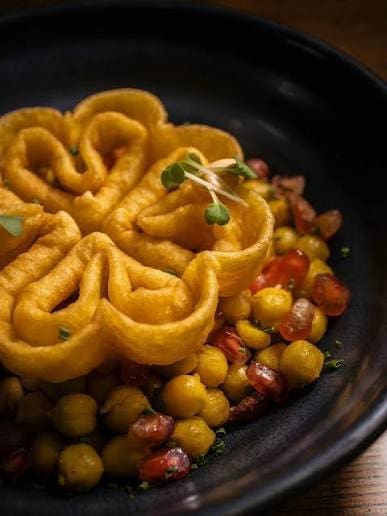
Photo credit: Casa Mikva
Grilled seasonal vegetables: carrots and the symbolism of abundance
Another option is the restaurant's seasonal grilled vegetables, which may include carrots accompanied by dried fruits or nuts.
Carrots have become associated with Rosh Hashanah in several Jewish culinary traditions. Sweet carrot dishes such as tzimmes are traditionally eaten by many families as a symbol of abundance and the hope that blessings will multiply during the coming year.
This connection should not be understood as a universal Sephardic Rosh Hashanah custom—traditions differ considerably between Jewish communities—but it provides another interesting link between seasonal food and the symbolism of the holiday.
This carrot starter tapa can be found at other restaurants in Seville, as it is a common dish in the city.
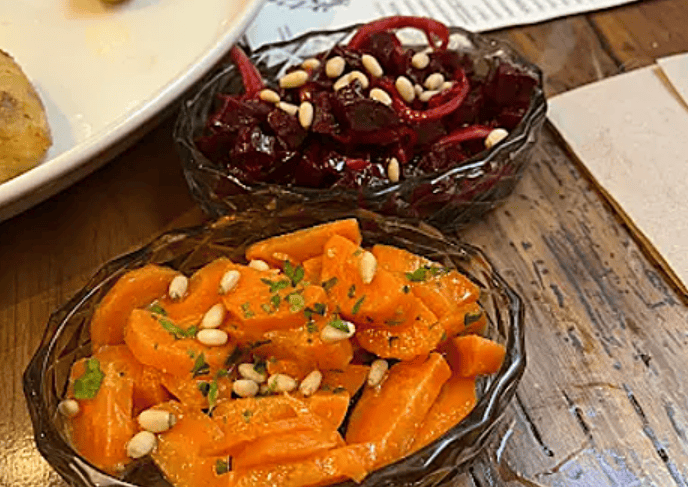
Photo credit: ABC
Apple pastela: a particularly appropriate dessert for the Jewish New Year
For dessert, one of the most interesting choices is:
Pastela de manzana asada, toffee y nueces pecanas con helado de Magallanes
The combination feels particularly appropriate for Rosh Hashanah because apple and sweetness are among the most recognisable symbols of the Jewish New Year.
One of the best-known Rosh Hashanah traditions is eating apple with honey while expressing the wish for a good and sweet year.
Casa Mikva's version is not a traditional Rosh Hashanah recipe. Instead, roasted apple is transformed into a contemporary dessert through pastela, toffee, pecans and ice cream.
It nevertheless offers a fitting way to finish a Sephardic-inspired meal during the Jewish New Year: familiar Rosh Hashanah symbolism expressed through the culinary language of modern Seville.
The dessert has also been highlighted among Casa Mikva's distinctive creations, alongside a menu designed around the culinary encounters between Sephardic, Arab and Christian traditions.

Photo credit: Casa Mikva
A table of three cultures in Seville
What makes Casa Mikva particularly interesting is that the experience goes beyond individual dishes.
Its concept reflects something fundamental about the history of Seville itself.
Techniques, ingredients and recipes did not develop inside perfectly separated religious communities. Medieval Iberian cuisine evolved through centuries of coexistence, movement, adaptation and cultural exchange.
Even something apparently simple such as a fried flower pastry can be claimed by Andalusi, Sephardic and Christian culinary traditions. Historical research into these dishes shows just how difficult—and often impossible—it is to assign them exclusively to one culture.
Casa Mikva embraces precisely this complexity.
Rather than attempting to recreate an exclusively medieval Jewish menu, it brings Sephardic, Arab and Andalusian influences together at the same table, mirroring the successive histories preserved within the building itself.
Is Casa Mikva kosher?
No. Casa Mikva should not be presented as a kosher restaurant.
Visitors observing Jewish dietary laws should therefore not interpret the restaurant as offering a kosher Rosh Hashanah meal or a religious holiday service.
The experience is better understood as cultural and gastronomic: a contemporary restaurant inspired partly by Sephardic culinary heritage, located within an exceptional historical setting connected to Jewish Seville.
For travellers interested in Jewish history, Sephardic culture and the former Jewish Quarter of Seville, this distinction is important.
Celebrating Rosh Hashanah through the history of Seville
Rosh Hashanah is ultimately about beginnings, reflection and remembrance.
In Seville, where much of the physical Jewish quarter disappeared or was transformed after the end of the medieval Jewish community, places such as Santa María la Blanca and the rediscovered mikva provide rare physical connections with that past.
A meal at Casa Mikva cannot recreate a traditional Sephardic Rosh Hashanah celebration.
But it can offer another way to engage with that heritage.
A Flor sefardí topped with pomegranate, seasonal vegetables recalling some of the symbolic foods associated with the New Year, and a sweet roasted-apple dessert create a culinary journey through ingredients that resonate particularly strongly during Rosh Hashanah.
And here, the setting matters just as much as the food.
You are eating in the former Jewish quarter of Seville, opposite a medieval synagogue transformed into a church, above structures that once served first as Arab baths and later as a Jewish ritual bath.
Few restaurants in Seville can tell that story before the first plate even reaches the table.
Shaná Tová — שנה טובה. May the year 5787 be a good and sweet one.
Practical information
Casa Mikva
Calle Santa María la Blanca, 18
41004 Sevilla, Spain
Casa Mikva currently serves breakfast, lunch and dinner and recommends reservations.
Important: Casa Mikva is not kosher, and the dishes described above should be understood as Sephardic-inspired or historically inspired cuisine, not as a traditional religious Rosh Hashanah menu.
Visit Seville with a licensed local guide
Private tours in English for couples, families and small groups, designed around what you want to see. Book online in two minutes, or send us your dates and we will get back to you within 24 hours.
- Official licensed guides
- Private tours, never a group
- Secure online payment
Book a private tour online
Prefer a tailor-made tour?
Tell us your dates, group size and interests. We can combine Seville with Córdoba, Ronda or an Iberian ham experience.
Chat on WhatsApp